
Thin Film X-Ray Diffraction Course: focusing on medium and high resolution applications (ACC Almelo)
June 15-19, 2026 | 9:00 - 17:00 CET | In-person | Almelo, The Netherlands
About The Event
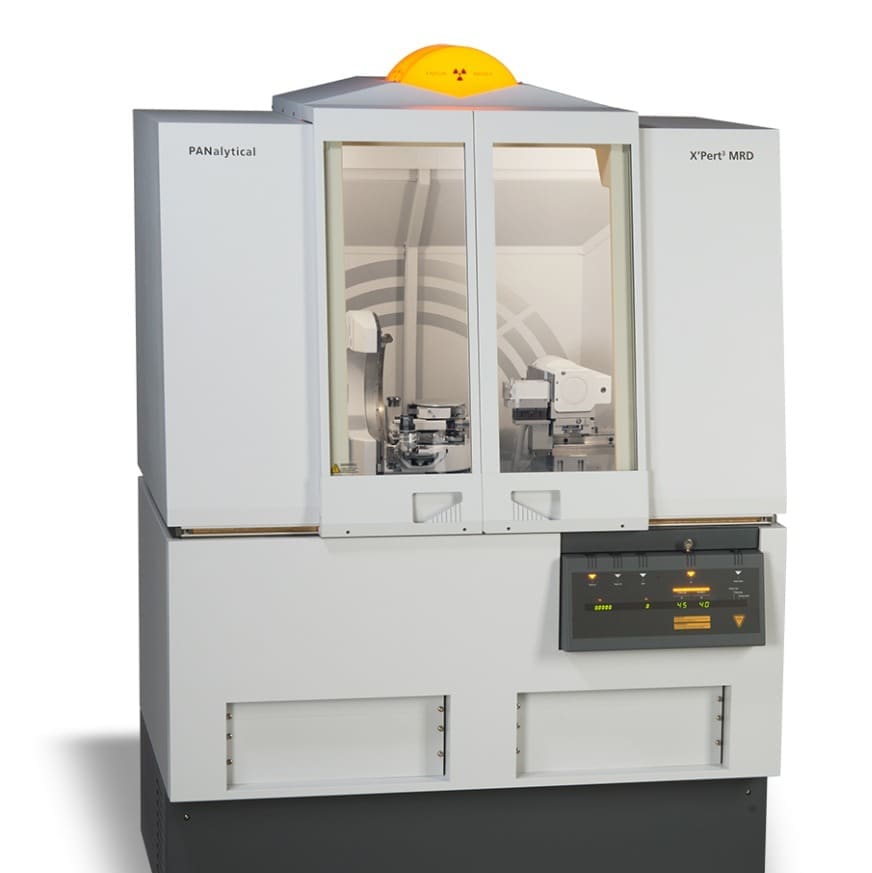
COURSE CONTENT The 5-day course will be held in the Application Competence Center of Malvern Panalytical (Almelo, The Netherlands), and it will cover the basic principles and practical aspects of a range of thin film-related X-ray diffraction techniques. The topics include high resolution XRD techniques commonly used for heteroepitaxial layers and medium resolution XRD techniques that are employed for fiber-textured layers, as well as X-ray reflectometry. We will also introduce reciprocal space, and how to navigate it to access different measurement geometries of thin film XRD experiments. To help you to get the best possible result out of your analysis, we will cover the principles of selecting the most appropriate hardware for your experiment, and compare the options. Each of the measurement types will be covered by theoretical sessions, practice sessions, and data analysis sessions in AMASS In addition to the practical and theoretical sessions, we will also spend some time on data analysis in AMASS software (including simulation and fitting of HR-XRD and XRR). As a participant you are encouraged to bring with you one or two of your characteristic samples (together with the corresponding safety data sheet). Depending on the participant’s backgrounds, Empyrean or X’Pert³ MRD (XL) system will be used. WHO SHOULD REGISTER Users with basic knowledge of crystallography and materials science, preferably with prior experience with Malvern Panalytical XRD systems. COURSE PROGRAM IN MORE DETAIL: The main aspects covered during the course are the following: • Basic principles of X-ray Reflectometry and High-resolution XRD; visualization of XRD experiment in reciprocal space; accessible geometries • Hardware components and their impact on data quality • Practical aspects of sample alignment procedure and data collection (reflectivity curves, high resolution rocking curves, reciprocal space maps, medium resolution scans) • Efficient use of line detectors for reciprocal space mapping • Extracting information from reflectivity curves: layer thicknesses from direct method and Fourier transform; model-based fitting; free-form fitting • Extracting information from rocking curves: calculating heteroepitaxial layer mismatch, composition and thickness; calculating periods for superlattices; calculating relaxation • Extracting information from reciprocal space maps: information from peak shapes; determining layer unit cell dimensions; studying relaxation in pseudomorphic systems.
More Information
This training is in-person, and it is offered free of charge. Travel and accommodation expenses are not included. Lunches are provided during in-person course days.
Course registration will close 3 weeks prior to the course starting date, or as soon as the class is full.
HOTEL CANCELLATIONS MUST BE SUBMITTED NO LATER THAN 3 DAYS BEFORE THE SCHEDULED CHECK-IN; A CANCELLATION FEE WILL BE APPLIED WITHOUT THIS ADVANCE NOTICE.
We reserve the right to cancel courses due to insufficient enrolment or unforeseen circumstances.
Don’t miss out - book your place

facebook twitterrssinstagramlinkedinyoutube